
Finding the Green Side of Seoul

Of course, whenever I find myself in a new city, one of my top priorities is tracking down a fabulous food tour. I have to say... I did a pretty good job with this one!
I ended up connecting with Veronica, one of the owners and guides of Korean Gourmet Hunters, and before I knew it, I had my very own private food tour through Seoul's famous Gwangjang Market.

What a place!
Gwangjang Market is an absolute feast for the senses... and definitely somewhere you want to arrive with an empty stomach and a sense of adventure.
Dating back to 1905, it's one of Seoul's oldest traditional markets... although these days it's perhaps best known for its incredible food scene. It's basically a maze of narrow aisles, crammed with vendors frying, steaming, stirring and serving up all sorts of Korean favourites. It's noisy, crowded, chaotic and genuinely bursting with character. Everywhere you turn, there's something sizzling, bubbling or tempting you to stop for just one more bite.
My favourite thing about markets like this is that the food is only half the experience. It's the people. The personalities. The stories behind the stalls. The generations of families who have been cooking the same dishes for decades. And, of course, there is that wonderful opportunity to catch a little glimpse of everyday life in a country so different from your own. Mine, anyway!
Veronica brought all of that to life for me.
She was fabulous. Knowledgeable, warm, enthusiastic and clearly passionate about both her country and its cuisine. She seemed to take so much delight in introducing me to unfamiliar flavours and watching my reactions as I tried them. I suspect she was hoping for a few surprises along the way. Now, had I not been vegetarian, there would have been a whole other world of Korean dishes for me to explore. But I am... and I'm quite happy sticking to the greener side of the culinary world. Thankfully, Veronica didn't see my vegetarianism as a problem or a limitation. Quite the opposite, actually. She enthusiastically took on the challenge of finding me some of the very best vegetarian food Gwangjang Market had to offer.
Believe me, she did NOT disappoint...
Gwangjang Market Gwangjang Market Gwangjang Market
Veronica started by giving me a little background on the market... sharing some of its history and stories, and then we dove right in. Our first stop wasn't far along one of the bustling aisles, where she motioned for me to take a seat on one of the tiny benches. This is one of the things I absolutely loved about Gwangjang Market. There are food stalls everywhere, many surrounded by little benches or stools where hungry customers squeeze in, point at whatever catches their eye, and enjoy their food right there on the spot. No fancy tables, no elaborate menus, no fuss... Just fabulous food being prepared inches away, with a front-row seat to all the action.
I don't think I witnessed a single slow moment in the entire market. The vendors were constantly on the move. Stirring enormous bubbling pots, chopping vegetables, soaking mung beans, sizzling batter on hot griddles, slicing noodles, folding and stuffing dumplings, frying, flipping, twisting, serving, collecting money... and somehow managing to keep track of everyone's orders in the middle of all that chaos. It was exhausting just watching them.
Every stall was like its own little theatre, with the vendors putting on a nonstop performance. Raw ingredients were transformed into steaming, delicious dishes right before my eyes, all through a blur of rhythmic, well-practised movements that made the whole process look ridiculously easy. There was no hesitation, no wasted movement, and certainly no standing around wondering what to do next. I couldn't help but wonder how on earth they kept up with it all. I think I'd last about ten minutes before getting hopelessly confused, dropping something on the floor or serving the wrong dish to the wrong person.

But these guys? Absolute pros.
And the best part? You get to sit right in the middle of it all, soaking up the atmosphere, watching the magic happen and eating some pretty incredible food at the same time.
The lovely ladies at our first stop were all smiles as we settled onto our little benches, ready to introduce me to my first taste of the market. And first up on the menu?
Tteokbokki!
They dished out a generous portion, plopped it down in front of us, handed us two pairs of chopsticks... and we were ready to dig in. Veronica is much like me when it comes to guiding food tours. She doesn't normally eat alongside her guests. But since I was her only guest that day, she decided to make an exception and join me in the feast. Food is always better when it's shared, especially with someone who knows exactly what you're eating.
Tteokbokki is one of South Korea's most beloved street foods. It's made with thick, cylindrical rice cakes simmered in a rich, sticky, spicy-sweet red sauce made from Korean chilli paste called gochujang. The rice cakes have a unique and unusual texture... soft, springy and chewy. The sauce is a combination of sweetness, heat and savoury. Apparently, it's considered the ultimate Korean comfort food. Not exactly delicate or dainty, but definitely memorable.
Then came Gimbap...
I think I declared these colourful little spirals of yummy my new favourite Korean food after only two bites. Perhaps slightly premature, considering I'd barely scratched the surface of Korean cuisine, but I was quite convinced I'd found a winner. Gimbap is made from steamed rice and assorted fillings, rolled tightly in a sheet of dried seaweed and sliced into perfect little bite-sized rounds. Very much like Japanese sushi rolls, but with a distinctly Korean personality. Ours were filled with fresh carrots and cucumber, all wrapped up in rice seasoned with sesame oil and salt. They just felt so healthy... which, of course, made me feel entirely justified in eating as many as I could manage.
After polishing off our tteokbokki and gimbap, we ventured farther into the market.
Making tteokbokki in the Gwangjang Market Korean Gourmet Hunters in the Gwangjang Market Gimbak in the Gwangjang Market
I was completely mesmerized.
Everywhere I looked, there was something happening. Steam rising from enormous pots, vendors shouting out orders, sizzling pans, colourful ingredients piled high and the constant movement of people weaving through the narrow aisles. The smells alone were enough to make you hungry all over again... even when you'd just eaten.
Veronica knew exactly where we were going in the middle of all this wonderful madness.
Our next stop was another busy little stall, home to a true superstar of Gwangjang Market. She was a second generation stall vendor and one of the most highly regarded makers of Nokdu Bindaetteok. These are traditional Korean savoury pancakes made from ground mung beans.
Ours were mixed with spring onions and fried until beautifully golden and crispy on the outside, while the inside was soft and savoury. They were served with a soy-based dipping sauce that added just the right amount of salty, tangy goodness.
Nokdu Bindaetteok are traditional Korean savoury pancakes Nokdu Bindaetteok are traditional Korean savoury pancakes Nokdu Bindaetteok are traditional Korean savoury pancakes
Oh my goodness, they were so good!
In fact, I loved them so much that my previous favourite, Gimbap, was suddenly facing some very serious competition. Here I was... only a few stops into my food tour, already having a full-blown internal debate about which Korean dish deserved the top spot.
And that's when Veronica produced the Makgeolli...
I have to admit, I was a little suspicious. She pulled out this rather odd plastic bottle filled with what appeared to be some sort of cloudy, milky-white liquid. It wasn't exactly screaming delicious to me. It looked a little sketchy. When she explained that it was a traditional Korean rice-brewed beer... I became even more hesitant.
Milky rice beer? Really? No...
But, as I always tell people on my own food tours... it doesn't matter whether you think you're going to like something or not, you have to at least give it a try! So, practising what I preach, I took a sip...

And WHOA!
I was completely blown away!
Makgeolli is a traditional Korean fermented rice drink with a cloudy, milky-white appearance and a slightly fizzy, almost creamy texture. It's a little sweet... a little sour... and has a gentle fermented tang that somehow brings everything together. It was unlike anything I'd ever tasted before.
Veronica explained that Makgeolli is particularly popular on rainy days in Korea, traditionally enjoyed alongside mung bean pancakes. There's actually a rather cool explanation behind this Korean tradition. The pitter-patter of raindrops against a window or rooftop is meant to resemble the sizzling of pancake batter hitting a hot frying pan. Apparently, that familiar sound is enough to get Koreans craving a plate of hot, crispy pancakes, washed down with a glass of cool, cloudy Makgeolli. I love discovering these little cultural traditions, especially when there's food involved. Who would have thought that the sound of rain could inspire an entire culinary ritual?
Apparently, it's the ultimate Korean rainy-day comfort-food combination.
And now I know why!
Even better... there was some Makgeolli left over, and Veronica told me I could take the bottle with me. Well... don't mind if I do!
Another new favourite to add to my rapidly growing list of Korean culinary discoveries.
With my bottle of Makgeolli in hand, we continued weaving our way through the wonderful maze of Gwangjang Market, stopping at a couple more stalls to sample some of Korea's beloved noodle and rice dishes. Every dish seemed to have its own personality. Seriously.
First up was Deul Kke Bibim Kalguksu.
Quite the name, eh?
Gwangjang Market Gwangjang Market Gwangjang Market
This dish features thick, hand-cut Korean wheat noodles tossed in a rich, nutty perilla seed sauce that gives them an almost creamy consistency. The noodles were wonderfully chewy, and the sauce was savoury.
Then came Bibimbap... one of Korea's most famous and colourful dishes. And a new favourite of mine!The name literally translates to mixed rice, which is exactly what it is. Imagine a bowl of warm rice topped with an assortment of fresh and cooked vegetables. Carrots, spinach, bean sprouts, cucumber and whatever else... all carefully arranged in a colourful display. My vegetarian version was a wonderful celebration of vegetables. A generous dollop of spicy gochujang sauce... and then... we mixed the whole thing up! It tasted a little like a Korean version of a poke bowl.

Sitting at this particular stall was an experience in itself. There were enormous bowls and piles of fresh vegetables everywhere. Greens, sprouts, shredded vegetables and all sorts of colourful ingredients, just waiting to be tossed into someone's dinner. A salad lover's dream!
One of the most heartwarming stories in Gwangjang Market belongs to Cho Yonsoon, whose little noodle stall gained international attention after being featured on Netflix's Street Food: Asia.
Her story is one of determination, family... and a whole lot of noodles.
When her family fell on difficult financial times and struggled with debt, Cho decided she needed to do something to help support them. Drawing on the noodle-making skills she'd learned from her mother, she began selling traditional Korean kalguksu (knife-cut noodles), from a small market stall. These aren't just any old noodles. They're made by hand, with dough rolled out and sliced into long, uneven strands before being cooked and served in a steaming bowl of broth. Traditional Korean comfort food, made with years of practice and a whole lot of love. Her beginnings weren't easy, but she persevered, slowly building a loyal following of customers who came back time and time again for her delicious homemade noodles.
Then came Netflix.
Suddenly, her little stall was attracting attention from around the world, with visitors eager to sit at her counter and taste the noodles that had helped her family through some incredibly difficult times.
This is exactly what I love about food tours. You're not just tasting food. You're watching traditions unfold... meeting the people behind the dishes and discovering stories you might never come across on your own. Behind all the sizzling pans, steaming pots and delicious food at Gwangjang Market are real people with real lives. People who have worked incredibly hard, often through difficult circumstances, to build something for themselves and their families. Sometimes, something as simple as a bowl of noodles can tell a much bigger story.
Gwangjang Market ~ Cho Yonsoon Gwangjang Market ~ Cho Yonsoon Gwangjang Market ~ Cho Yonsoon
That's the magic of places like Gwangjang Market.
It was here, with Cho Yonsoon, that Veronica introduced me to a couple more dishes that were unlike anything I'd tried before.
First up was Woomu Bibim, a spicy Korean agar salad. Now, this was an interesting one. Woomu Bibim is made from delicate, jelly-like strips of seaweed-derived agar, tossed in a spicy, tangy dressing. It's light, refreshing and has a slippery, almost wobbly texture that's quite unlike your typical salad. A little bit of spice, a little bit of tang, and a whole lot of interesting texture.

Next came Naengmyeon, Korea's famous cold buckwheat noodles. Naengmyeon is traditionally made with long, wonderfully chewy noodles served in a chilled, sometimes icy broth. The broth is light, slightly tangy and incredibly refreshing, while the noodles have a distinctive slippery, springy texture.
So many delicious bowls... so many unfamiliar flavours... and so much food that I was beginning to wonder whether I'd seriously overestimated the capacity of my stomach. I have to admit, by the time the Woomu Bibim and Naengmyeon arrived, I was struggling.
I was full.
Really full.
But there's always that mysterious little pocket reserved exclusively for dessert, right?
Thank goodness, because our next stop was for Hotteok.
Oh.
My.
Goodness.
If there was ever a reason to save room for dessert in Korea... this was it.
Hotteok is a traditional Korean sweet pancake... and it's every bit as delicious as it sounds. Do NOT miss out on this sensational dessert! Imagine a golden, slightly crispy pancake with a soft, chewy dough and a molten centre filled with brown sugar, cinnamon and chopped nuts. As it cooks on the hot griddle, the sugar melts into a glorious, sticky, syrupy filling that's just waiting to ooze out with your first bite. It's sweet, warm, gooey and wonderfully indulgent.
I was in heaven.
That was it. I'd found my winner!!
Forget the gimbap. Forget the mung bean pancakes. Forget the bibimbap. Forget makgeolli. Forget everything I'd declared as my favourite over the past couple of hours. Hotteok had just stolen the show. I happily devoured every last bite, convinced that nothing could possibly top it.

And, quite frankly... I was convinced that this had to be the end of the tour.
Of course?
Veronica casually informed me that we had one more stop.
ONE MORE?
I must have had a look of absolute disbelief on my face, because I was genuinely beginning to worry that my stomach was about to explode. Thankfully, Veronica seemed to recognize that I was reaching my limit and suggested we take a leisurely walk along the nearby Cheonggyecheon Stream before continuing.
What a fabulous idea!
Not only did it give me a chance to walk off at least a fraction of the enormous amount of food I'd just consumed, but it also introduced me to another fascinating little piece of Seoul's history. Cheonggyecheon is a beautiful urban stream running through the heart of the city. Originally a natural waterway dating back centuries, it played an important role in Seoul during the Joseon Dynasty. Over time, however, it became increasingly polluted, eventually turning into something resembling an open sewer.
During the rapid modernization of Seoul in the 1950s through the 1970s, the stream was covered over with concrete, and an elevated highway was built above it. For decades, it disappeared beneath the city's traffic and development. Then, in an extraordinary urban restoration project between 2003 and 2005, the highway was removed, the concrete was torn up, and the waterway was brought back to life. Today, it's a lovely green corridor winding through the middle of one of Asia's busiest cities, with walking paths, little bridges and places to sit and escape the surrounding chaos. One minute you're surrounded by traffic, skyscrapers and the relentless energy of Seoul, and the next you're strolling beside flowing water, almost forgetting you're in the middle of a massive metropolis.

It was exactly what I needed. A little fresh air... a bit of exercise... some fascinating history and... most importantly... a chance to make room for whatever Veronica had planned next.
Our final stop was a traditional Korean teahouse called The Ssanghwa, just a short walk from Gwangjang Market. Stepping inside felt like stepping into another era. The interior was cozy and retro... with the most incredible herbal aromas drifting through the air.
Here... I was introduced to Ssanghwa-cha, a traditional Korean herbal tea. Before I say anything more, I need to make something perfectly clear.
I am NOT a tea drinker.
Never have been.
I don't particularly enjoy tea, I don't crave tea, and I certainly don't go out of my way to find tea.
But... this tea was something else. Second level..
Ssanghwa-cha is not your average cup of tea. Calling it tea almost seems cheap... like we're underselling the whole experience. It's a rich, dark, aromatic herbal brew traditionally prepared with a mixture of roots, herbs and spices... and has long been associated with warmth, comfort and traditional Korean wellness practices.
The flavour was extraordinary. I could detect hints of cinnamon, licorice, ginger, honey and something almost eucalyptus-like, along with all sorts of other flavours I couldn't begin to identify. Every sip seemed to reveal something new.
And I couldn't get enough of it.
Me!
The girl who doesn't drink tea!
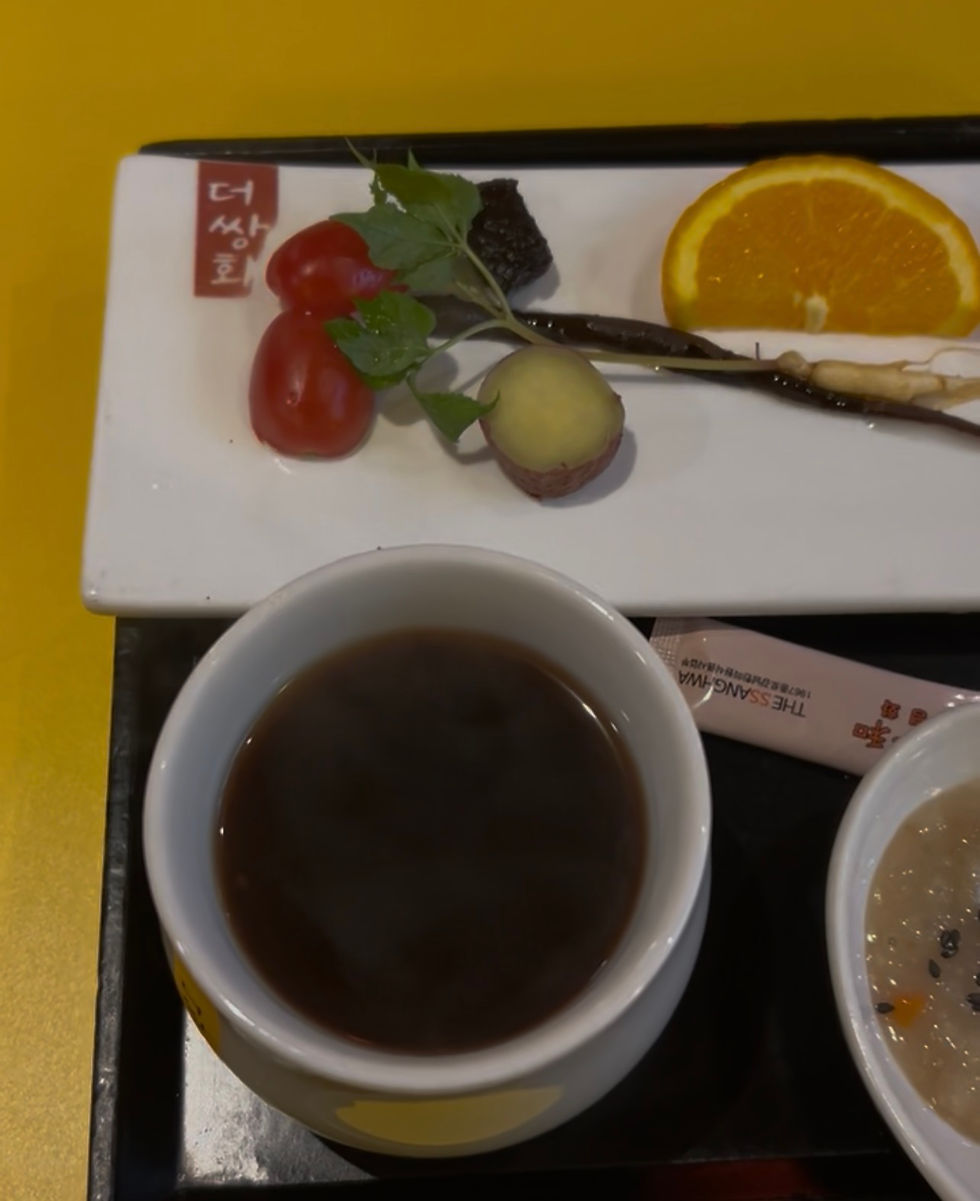
But the experience didn't stop with the tea itself. It arrived as part of a beautiful little set, accompanied by rice porridge, ginseng, orange and an assortment of other traditional treats.
It was almost like a little ceremony... with all these interesting flavours and textures laid out in front of me. We sat there enjoying the tea, chatting and reflecting on the incredible feast I'd just experienced.
I was completely smitten. So much so that I bought three packages of Ssanghwa-cha to take home with me.
Three!
I probably would have bought more, but travelling with limited luggage space does have its disadvantages. Who would have thought that one of my favourite discoveries in Korea would be tea? Certainly not me...
And with that, my wonderful food adventure finally came to an end.
I had arrived at Gwangjang Market hungry, curious and eager to discover a little more about Korean cuisine. I left absolutely stuffed... carrying a bottle of Makgeolli, three packages of herbal tea and a whole collection of new favourite foods that I was already looking forward to eating again.

But more than that, I left with a much greater appreciation for the people, traditions and stories behind the food. For that, I have to give an enormous thank you to Veronica and Korean Gourmet Hunters.
The food was spectacular. How could it not be? From crispy mung bean pancakes and colourful gimbap to sweet, sticky hotteok and that unforgettable herbal tea... every stop brought something new and delicious.
But what really made the experience special was Veronica herself. She was knowledgeable, enthusiastic, generous with her time and genuinely passionate about sharing her country's food and culture. As a fellow food tour guide, I know just how much difference a great guide can make.
Veronica didn't simply take me from stall to stall and hand me things to eat. She introduced me to the people, explained the traditions, shared the stories and made sure that my vegetarianism never meant missing out on the experience.
She went out of her way to make the evening memorable... and she certainly succeeded.
I've always believed that food is one of the very best ways to get to know a country. It's not just about what ends up on your plate. It's about the people who prepare it, the traditions that surround it, the stories behind it and the conversations that happen while you're sharing it.
And this tour was a perfect example of exactly that.
If you're heading to Seoul, I can't recommend Korean Gourmet Hunters highly enough.
Just make sure you arrive hungry.
Very, very hungry.


Comments