
DMZ : Disneyland of Disarmament

Maybe ever since I did that enormous Middle East camping tour, I've been a little turned off tours. I don’t know. But obvioulsy I keep going back for more.
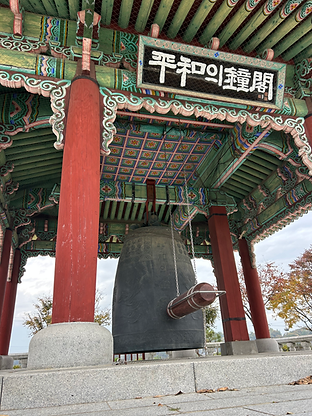
Why?
Perhaps I'm just a glutton for punishment.
I don't know.
What I do know is that after today's DMZ tour, I'm beginning to think I just don't have the patience or tolerance for group tours anymore. From here on in, any tour offered will have to promise me 100% nonstop exhilaration, thrills... and enough entertainment to keep me from contemplating my own mortality before I'll willingly climb aboard another bus.
I didn't do a whole lot of research before booking this one. My bad. I just figured visiting the DMZ was one of those things you simply have to do when you come to Korea. Or at least Seoul.
Right?
The Demilitarized Zone (DMZ) is the heavily fortified strip of land separating North and South Korea. And... when you think about it... it's actually intensely fascinating. The Korean War, which began in 1950 and technically never officially ended, the attacks from North Korea, the tunnels dug beneath the border, the history of the division, and even the controversy surrounding the 1988 Olympics... and more. There's a lot to unpack.
And I love history.
Especially war history.
But today's experience wasn't quite the historical deep dive I had imagined. Not at all.
Does anyone remember the movie About a Boy? There's a scene where the mother and son are singing "Killing Me Softly" by Roberta Flack, while Hugh Grant's character is forced to sit through the whole thing. He consoles himself with the thought that eventually the song will end, he'll be back in his own bed, and this whole miserable experience will be behind him.
He knows it will end. He just can't feel it.
That. Was. Me.
Abandoned train after being riddled with more than 1,000 bullet holes during the Korean War Abandoned train after being riddled with more than 1,000 bullet holes during the Korean War Abandoned train after being riddled with more than 1,000 bullet holes during the Korean War
Our tour guide never stopped talking. Not once. It was beyond excessive. And because I had managed to secure one of the front seats, I was positioned directly beside the microphone. Eight hours of listening to someone speak through a loudspeaker from approximately six inches away.
Her English was… meh… but quite choppy… and listening to choppy, broken English amplified through a microphone when you're jet-lagged is not exactly my recipe for a super day. She did keep telling us that she was going to let us relax for a bit. Which was lovely. Except she would then carry on talking...
... and talking.
... and talking.
... and talking.
Repetitive commentary. And twice.
Yes... she said everything twice. Like Jacob Two-Two.
At one point, she sang us a song.
She also consistently referred to us as "my group, my group." Which is perfectly understandable when you're trying to identify your group amongst a crowd of other groups. But when we're all sitting on the same bus, I'm fairly certain we know which group we're in.
She was running on what seemed like 47 cylinders... and was, without question, the most enthusiastic guide I've ever encountered. A giant smile was permanently plastered across her face... and her energy levels never seemed to dip. As a tour guide myself, I should probably appreciate that kind of enthusiasm.
And part of me does. Honest.
But another part of me was sitting there wondering how on earth she managed to maintain it for so long... and wishing it would just STOP.
Now. Please. Don't get me wrong...
There were... thankfully... brief moments of genuine significance throughout the day... and certainly a few moments of sadness.
We saw an old train that had been left abandoned after being riddled with more than 1,000 bullet holes during the Korean War. I couldn't help but wonder about the people who had travelled on it, the lives that had been lost, and the stories that would never be told.
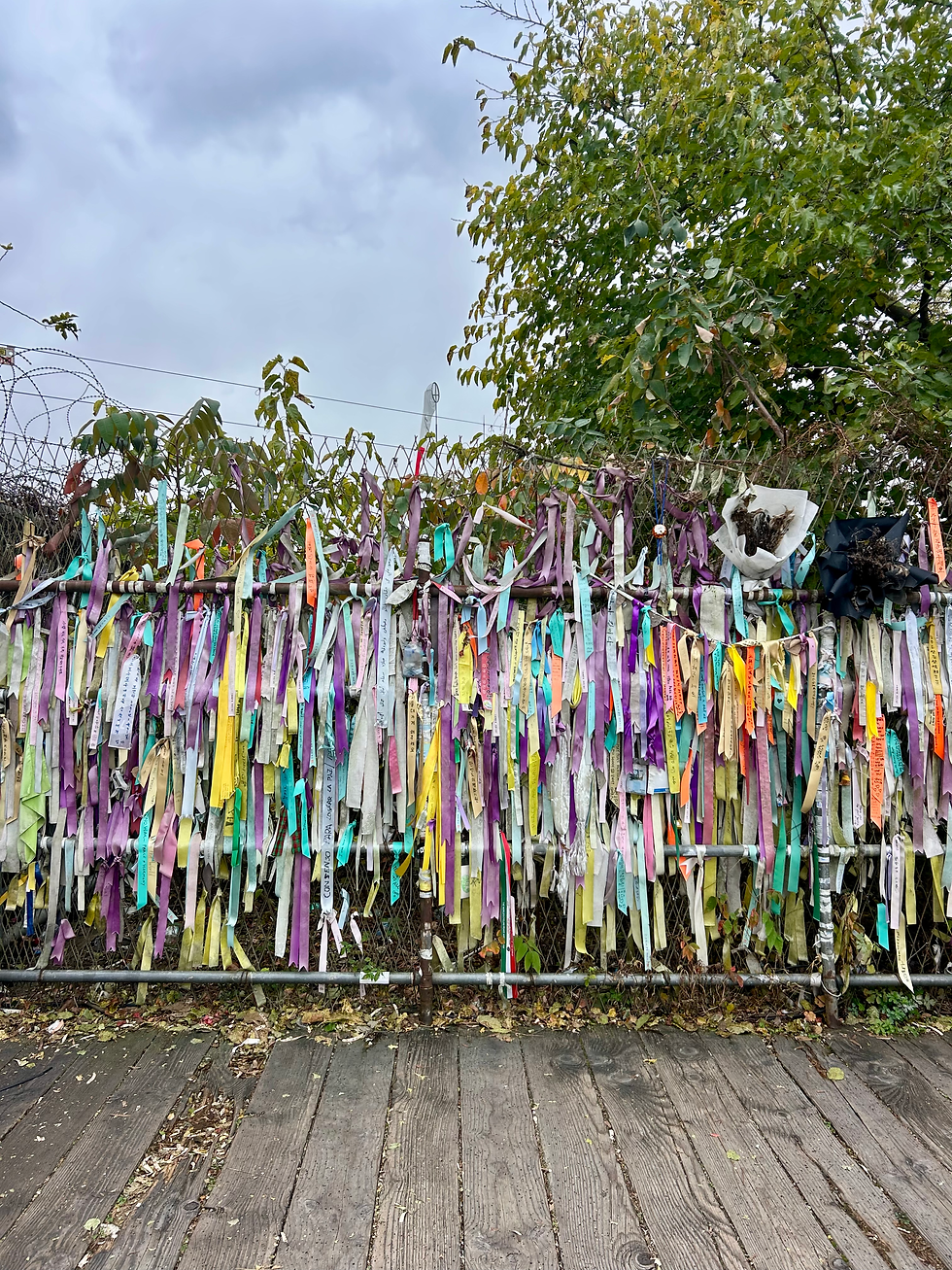
There were also walls of colourful ribbons tied along the fences. Each ribbon carries a message of hope, remembrance or longing. Some express the wish that North and South Korea will one day be reunited. Others are prayers for peace, messages from people hoping to see family members again, or tributes to those who lost their lives.
Many of these messages are deeply personal. Imagine having spent more than 70 years wondering whether your parents, siblings or children are still alive on the other side of a border you can never cross.
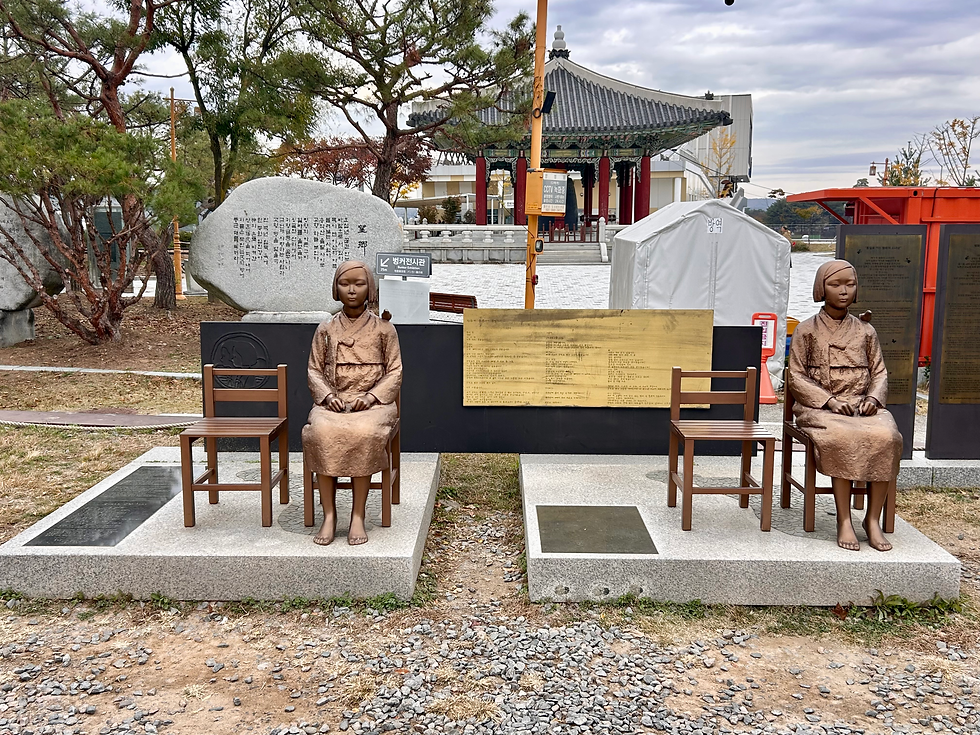
And then there were the two bronze statues of young girls sitting quietly together.
Known as the Statues of Peace, they commemorate the Korean girls and women who were forced into sexual slavery by the Japanese Imperial Army during World War II. These women, often referred to as comfort women, endured horrific abuse and had their stories silenced for decades. One represents South Korea and the other North Korea, symbolising the hope that the two countries might one day be reunited.
These were the moments that reminded me why I'd wanted to visit the DMZ in the first place.
Behind the cartoon displays, the multitude of souvenir shops and the busloads of tourists, there is an extraordinary amount of history, heartbreak and unfinished business.
I wish we'd spent a whole lot more time talking about that.
It was also freezing. Baltic. Despite layering up, I had obviously lost my battle against the frigit cold. At one stop, I walked myself into one of the many shops and bought myself another sweater. I was tempted to add a new pair of socks, a toque, a scarf and mittens to my shopping basket... but I had to show some financial restraint. I can't afford to buy an entirely new winter wardrobe every time the temperature drops.
Besides, with so few options, the sleeves on my new sweater were slightly too short, which annoyed me more than it probably should have. At least it kept me warm(er).
In hindsight, I think I would have been perfectly happy on a smaller, more history-oriented DMZ tour. Something with fewer people, more substance, and perhaps a guide who understood that silence is occasionally golden.
But that wasn't what I had signed up for.
I was one of approximately 50 or 60 people on a bus tour that was just one of several busloads. There were hundreds of people doing the same tour.
Everywhere we went, I found myself demonstrably underwhelmed. Not necessarily because the places weren't beautiful or interesting, but because they lacked the significance I had expected.
So much of it felt... Disneyfied... If that makes sense??
Everything was cartoonish.
Overly cheerful.
Overly tacky.
At one point, we watched a museum video narrated by a man discussing the area between North and South Korea. His delivery involved a lot of dramatic voice raising, followed by this exaggerated, Disney-esque enthusiasm that made it sound as though we were about to embark on the happiest adventure of our lives.
It was all very cheerful. Suspiciously cheerful.
I came away feeling like I'd watched more fairy tale propaganda than historical information.
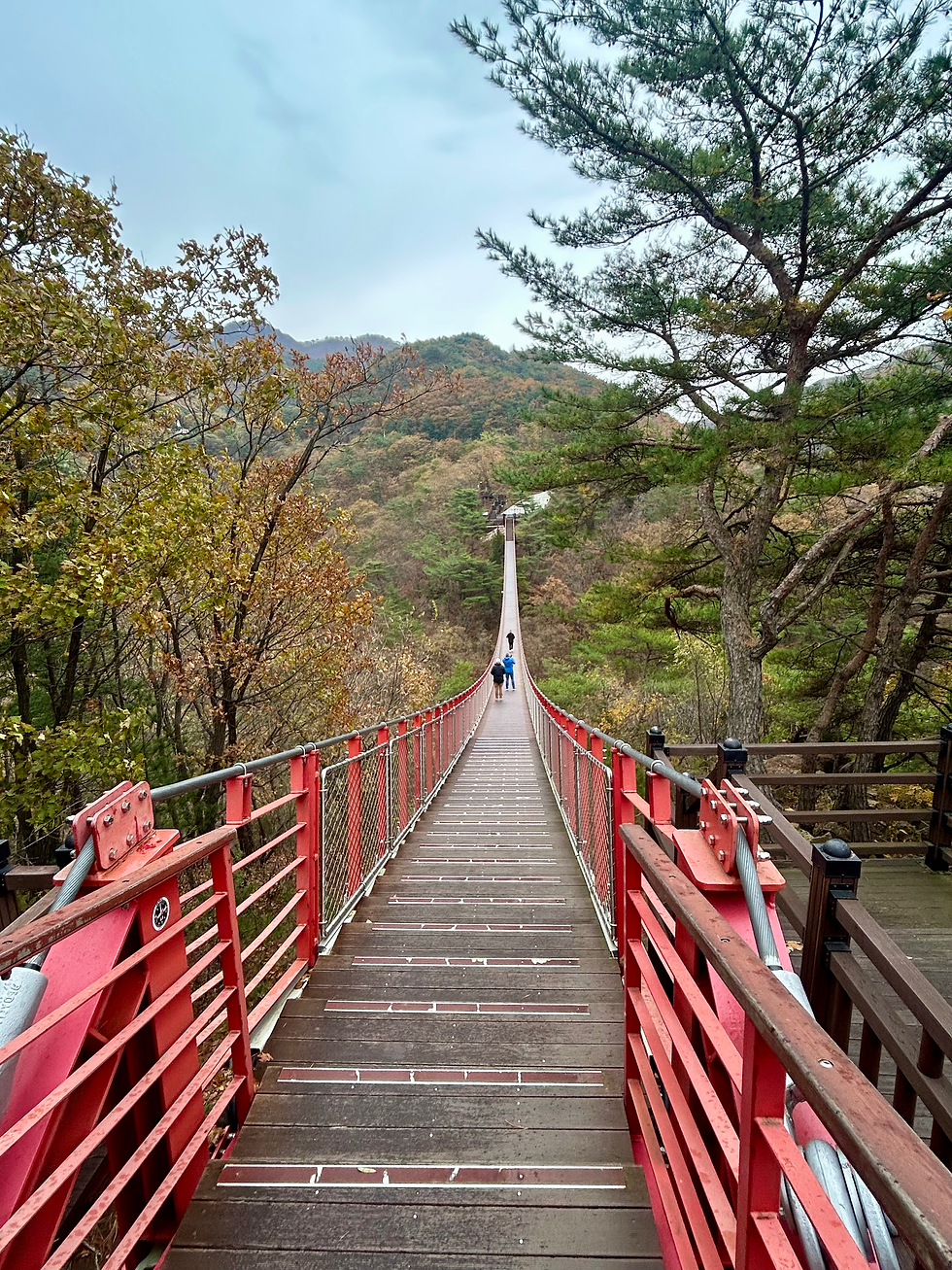
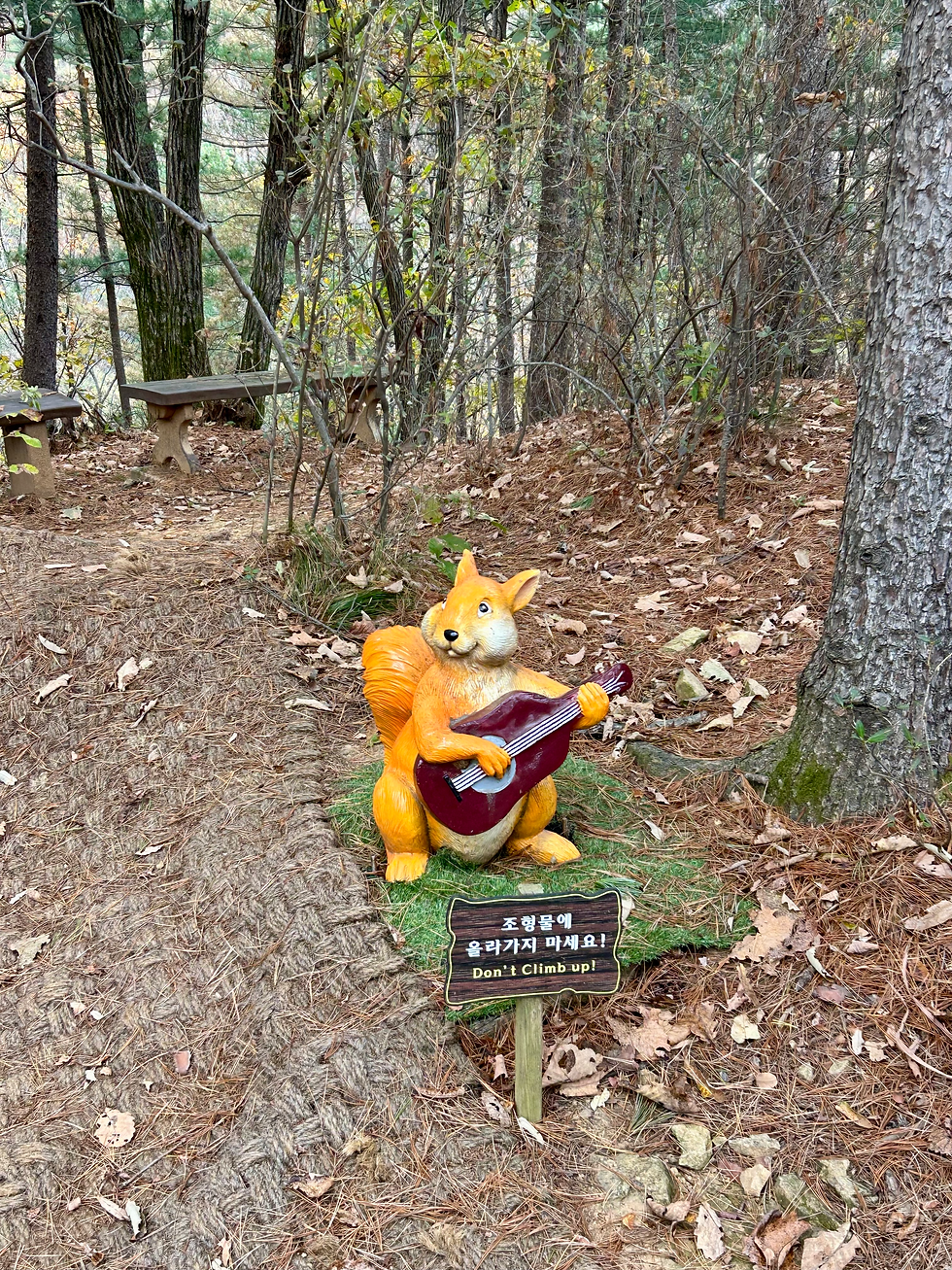
Then there was the little walk up a small mountainside to cross a suspension bridge built over one of the valleys in the DMZ. Along the way, they'd positioned cute little bunnies, plastic deer and various furry woodland creatures. I honestly felt more like I was visiting Storyland Trails than an actual military buffer zone separating two countries that are technically still at war.
Did I mention the amusement park in one of the parking lots??
And let me tell you, nothing says historical military significance quite like crossing a suspension bridge alongside busload after busload of tourists.
At one of the museums, there were these elaborate scale models of the surrounding area, complete with representations of the tunnels, fences, buildings, bridgers and military installations. They were meant to give you a better understanding of the geography and the division between North and South Korea. Except someone decided these serious military models needed a few not-to-scale cartoon-like, plastic birds and little birds' nests scattered throughout the landscape.
I don't even know how to describe it.
It was silly.
Even the life-sized military figures looked like mannequins salvaged from an old department store window. Perfectly sculpted cheekbones, lipstick, camouflage uniforms and guns. Surreal.
We did have the opportunity to descend into Tunnel Number Three, one of the tunnels discovered beneath the DMZ. Apparently, it involved squeezing through a passage approximately two metres wide and two metres high. I have experienced bouts of claustrophobia in the past, and the thought of doing this, cold… and with hoards of other people wasn't particularly appealing. I decided I wasn't going to risk having a panic attack... and opted to stay on the bus.
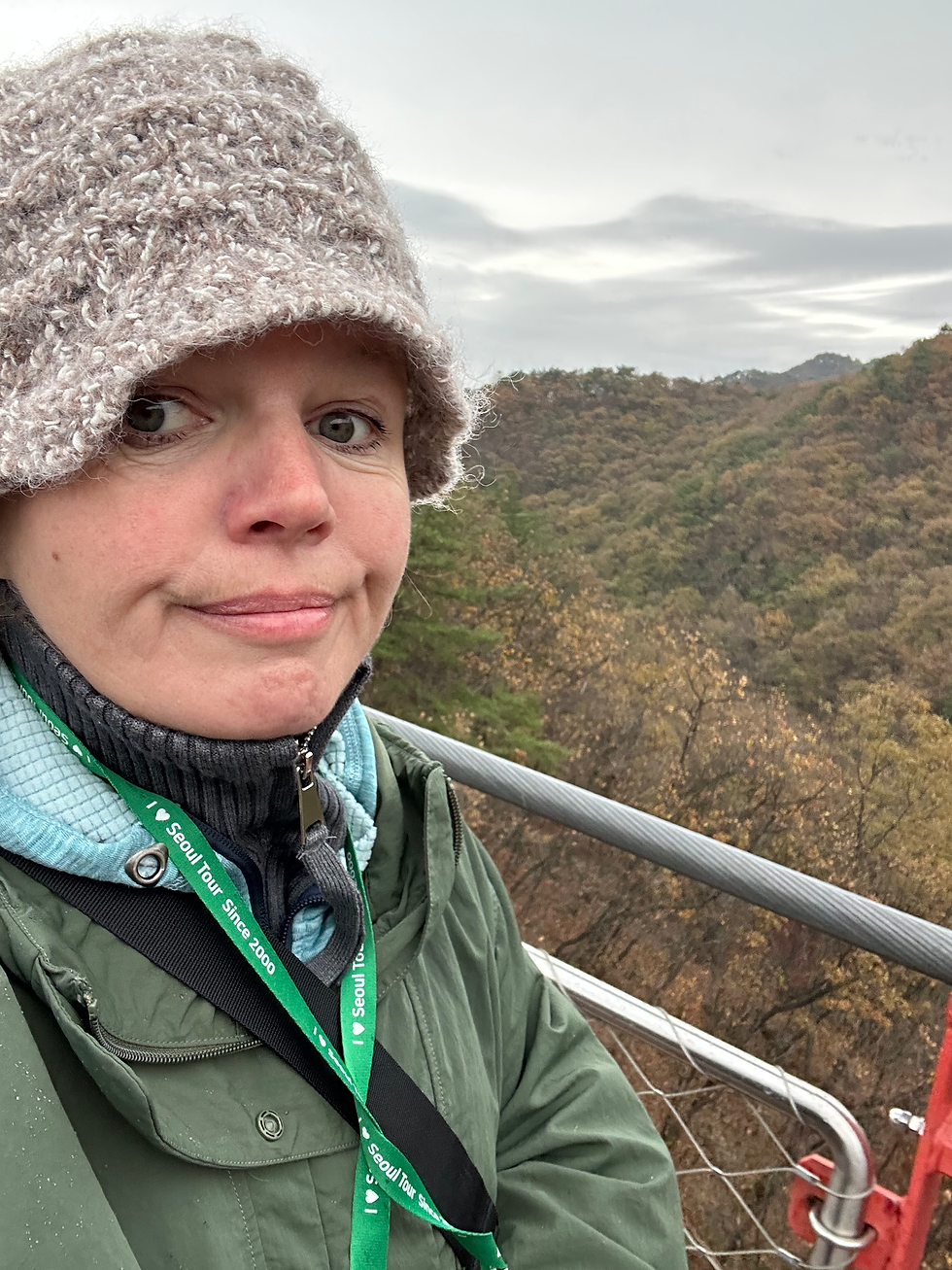
No regrets.
At one point in the tour, I went to get off the bus and managed to catch the back of my leg on the armrest. I went flying backwards into the seat so hard that I gave myself a Charlie horse.
Now… the day was complete.
It's sad to say it, but I was very disapopinted. I really did want to learn more. I wanted the history, the stories, the politics, the military significance and a better understanding of what life is like on either side of this extraordinary border. Instead, I got a very long bus ride, a relentlessly enthusiastic tour guide, cartoon woodland animals, questionable museum displays and a new sweater with sleeves that were too short.
I actually went online to see whether other people had enjoyed the tour. When I booked it, it looked like one of the more popular options and was apparently quite likely to "sell out." Surely I couldn't be the only person who had found the whole experience a little underwhelming?
As it turns out, there were quite a few less-than-glowing reviews.
I should have done a little more research.
Next time…
Or perhaps I'm just reaching that stage of travel where I want to do things my own way, at my own pace, without someone narrating every single kilometre of the journey through a microphone.
A little factual information on the DMZ

On June 25, 1950, North Korean troops crossed the 38th parallel and invaded South Korea. The invasion triggered a major international conflict.
South Korea was supported by a United Nations force led by the United States.
North Korea was supported by China and the Soviet Union.
Chinese troops eventually entered the war in enormous numbers, helping North Korea push back UN forces.
The fighting was brutal. Seoul changed hands several times, cities were destroyed, millions of people were displaced and an estimated 2.5–3 million people, including civilians, died. The war also divided countless families. Parents, children, siblings and spouses suddenly found themselves on opposite sides of a border they could no longer cross.
In July 1953, an armistice agreement was signed, bringing active fighting to an end. But here's the important distinction: the two Koreas never signed a formal peace treaty. The war stopped, but technically, the conflict was never formally concluded. As part of the 1953 armistice, a buffer zone was established between the two opposing military forces. This became the Demilitarized Zone (DMZ).
It is approximately 250 kilometres long and approximately 4 kilometres wide.
It runs across the Korean Peninsula, roughly following the final ceasefire line.
Each side withdrew its troops approximately two kilometres from the Military Demarcation Line.
It is heavily guarded along outer edges, with fences, surveillance equipment, landmines & military installations.
Despite being called a demilitarized zone, it sits between two of the most heavily militarised forces in the world.
The DMZ is significant for several reasons:
📍It represents a divided nation. Millions of Koreans have lived their entire lives separated from relatives across the border. Some families were divided during the war and never saw each other again.
📍It represents the unfinished Korean War. The 1953 armistice stopped the fighting, but no formal peace treaty was signed.
📍It represents the Cold War. The division of Korea was one of the most visible consequences of the ideological struggle between communism and Western-backed anti-communism.
📍It represents an ongoing security concern. North Korea continues to maintain a substantial military capability, and South Korea maintains a strong military alliance with the United States.
DMZ - South Korea DMZ - South Korea DMZ - South Korea

Thanks for the end bits about the history. Certainly does sound like the landscape “embellishments” were a bit over the top!